Alderson Disc
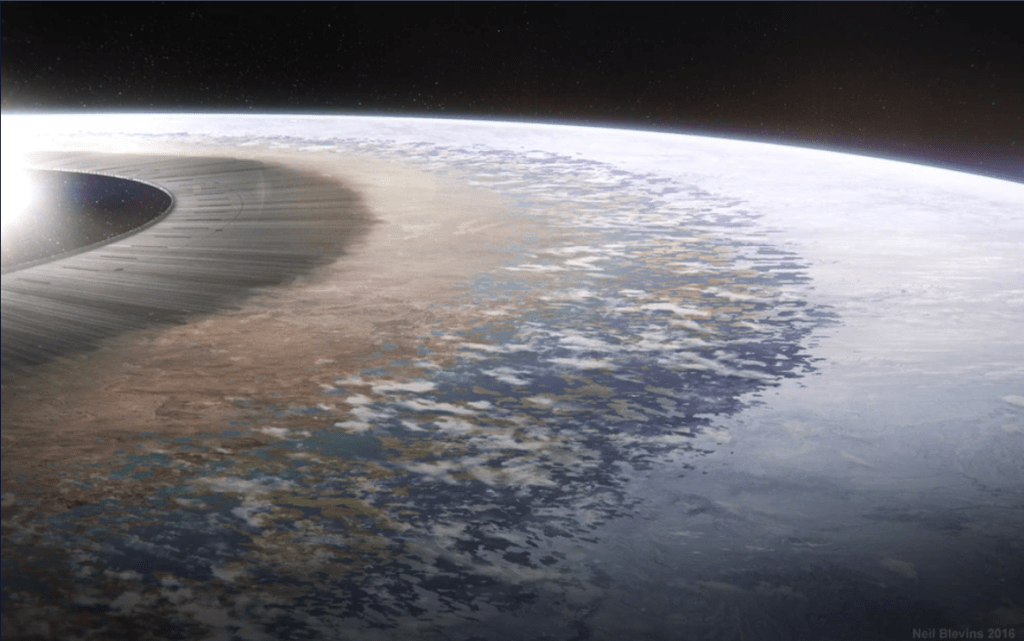
An Alderson disc, named after Dan Alderson, is a disc shaped structure with a 1.5AU – 5AU radius. As a Because We Can structure, it has many design flaws.
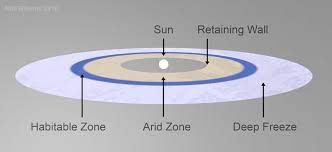
At its thinnest point, an Alderson disc’s base material is thousands of kilometers thick. The inner & outer wall is several thousand kilometers high, and holds in the atmosphere. Both sides of the disc can hold habitat zones. Radiation, heat & other factors limit the living space to a narrow band 1AU – 3AU depending on star class. The uninhabitable zones could be used for industry, life support zones, alien life, or disc-evolved life.
Day and night cycles are regulated by the sun ‘bobbing’ up and down between the top and bottom of the disc. Sun movement would be visually limited to the horizon. In place of moving the star, shade panels can be installed to provide to provide day/night slices across the disc.
Gravity is ~1G throughout the structure. Concentric rings radiate from the center. Each ring is a filled tube with dense spinning matter. The matter density of this mass is greater at the center, and less at the discs outer edge. This counteracts the centrifugal gravity of a spinning disc.
Alderson Model – Statistics
| Circumference (star to edge): 3AU – 10AU | |
| Thickness: +5,000km | |
| Livable Area: 50m Earths | |
| Gravity: .2G- 1G |


 BOOTSTRAP PROTOCOL